
The Body Remembers What the Mind Forgot
What Woodstock 99 cracked open twenty-seven years later
This is Part 1 of a four-part series on identity, culture, and what watching Woodstock 99 cracked open in me decades later. This one’s about the body, and what it remembers even when the mind has moved on.
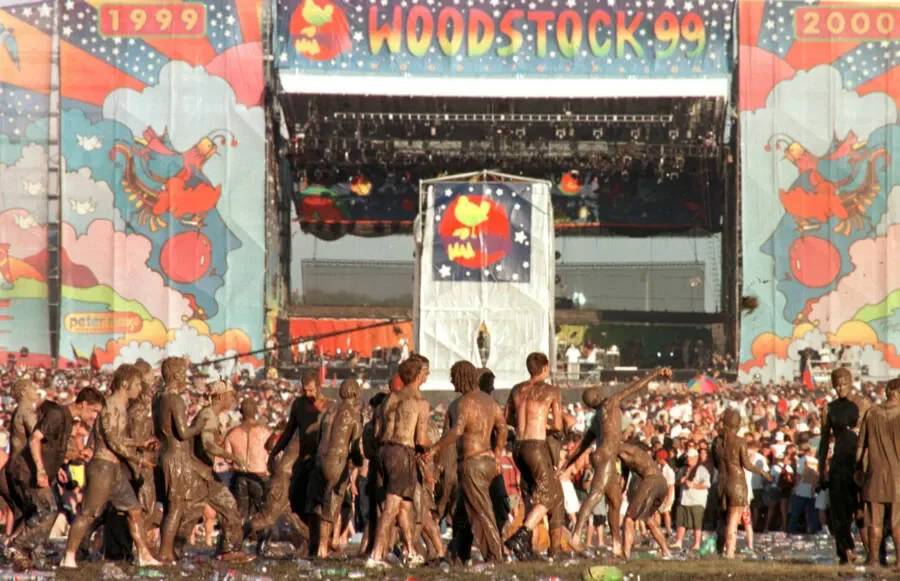
I clicked play expecting a trip down memory lane.
Woodstock 94 happened when I was young enough for it to feel mythic, and honestly, in 1994, 1969 felt like it was ages ago at the age of 15. The 60s were having a moment again, at least in my personal world. Bell bottoms, peace signs, that whole “love is the answer” aesthetic I fell hard for without fully understanding what I was falling for. Forrest Gump was in every theater. The music from that era felt like it had been waiting for me my whole life. I got wrapped up in it, the way you get wrapped up in a story that feels like it belongs to you even though you weren’t there.
So when the Woodstock 99 documentary showed up in my recommendations, I thought, this’ll be fun. A little nostalgia…a look at what I missed.
I remember being twenty when it actually happened, and even then something felt off. Why do this again, five years after the big reunion anniversary in ‘94? And the lineup didn’t match the spirit of the original. It was aggressive where the original was soft. Limp Bizkit, ICP, and Korn instead of, well, whatever “peace and love” would have booked. Jewel was there too, almost like the organizers wanted to say, see, we kept the spirit of Woodstock alive, even while the rest of the lineup was built for something else entirely.
I sat down expecting memory. I did not expect my body to remember something it hadn’t agreed to revisit.
There’s a moment in the documentary where they show how the girls at that festival were treated. Grabbed. Groped. Handled like nobody’s property but everyone’s to take. And something in me went off before my brain caught up to why. Oh my God. Yes. That is exactly the shit we had to deal with.
We were public property back then. Anyone could grab us if they wanted to, and there wasn’t much recourse, because nobody would believe us. We were “dressed wrong”, or “provocative”, or we’d been drinking, or any number of other reasons that always somehow landed the blame back on us. And it wasn’t just that one festival teaching us this. It was John Hughes movies, it was Revenge of the Nerds, it was every teen comedy we grew up loving that taught us this was simply how things were, funny even, expected. I remember how powerless that felt. I remember how it stole moments that should have been pure joy from an entire generation of women, and the generations before us too.
Here’s what I know now that I didn’t have language for then. Expressing myself sexually, dressing a certain way, dancing a certain way, feeling good and free in my own body, was never permission. It was never an invitation. That was between me and my body. It had nothing to do with anyone else’s hands. But the culture at that time collapsed the two into one thing, treated any woman enjoying her own body as an open door, no matter the circumstances. That confusion wasn’t ours to fix. It was never ours to begin with.
That feeling doesn’t go away just because the culture eventually caught up a little. We’ve had Me Too. We’ve had more women speaking their truth. We’ve had real, hard-won progress since then. But progress doesn’t erase what your body remembers. It doesn’t undo the wiring. That documentary put me right back in it, the exact feeling, like no time had passed at all. It was a time-capsule that I momentarily felt should have stayed buried, until I realized the gift it was.
The thing I kept coming back to, sitting there on my couch decades later, was my girls. I hope they never carry this. I hope they don’t grow up doing the math I did at fifteen, at twenty, the constant quiet calculation of should I wear this, will someone say something, will someone touch me and call it my fault.
Those are the moments that shape identity. Not one moment, but the accumulation of them, the years of learning I am this kind of person, or I am disposable, because that’s how I kept getting treated.
But something else showed up watching that documentary besides the old ache. Anger. Real, current, 2026 anger. Because the footage did something I didn’t expect. It validated me. It said, out loud, on screen, decades later: that was real. That was bad. You were not imagining it, and you were not overreacting, and the world does not get to tell you otherwise anymore.
And once something validates what you knew in your body all along, you don’t just get to set the old identity down. You get to want it back. Not the fear. The fire. My sexuality was never the problem. It was never an invitation. It was mine, and I want her back, fully, unapologetically, on my own terms this time.
